
Introduction
In the rapidly evolving landscape of automation and artificial intelligence, FigureAI is an emerging startup in humanoid robotics field that has backing of investors like Microsoft, Nvidia, Amazon and more securing $675 million in funding and looking to raise $1.5 billion at a valuation of $39.4 billion (Source: Bloomberg). Their cutting-edge creations, including the Helix Robot AI and Figure 02 Robot, are poised to start offering automation services in sectors from manufacturing to healthcare. By combining advanced AI with human-like dexterity, these robots promise to redefine efficiency, safety, and scalability in the workplace.
Helix: Agility Meets AI
At the core of FigureAI’s ecosystem lies Helix Vision Language Action (VLA) model, that offers approaches to object handling, agility, multi robot collaboration and AI integration. Designed to navigate dynamic environments, Helix uses machine learning algorithms to adapt in real-time to tasks like object manipulation and spatial problem-solving. Its lightweight, modular design allows seamless deployment in settings ranging from warehouses to construction sites. According to FigureAI’s official website, Helix’s architecture enables it to collaborate with multiple robots, learning from single set of neural network weights to optimize workflows. This adaptability makes it a cornerstone for industries seeking flexible automation.
Figure 02 Robot: A Leap Forward in Design
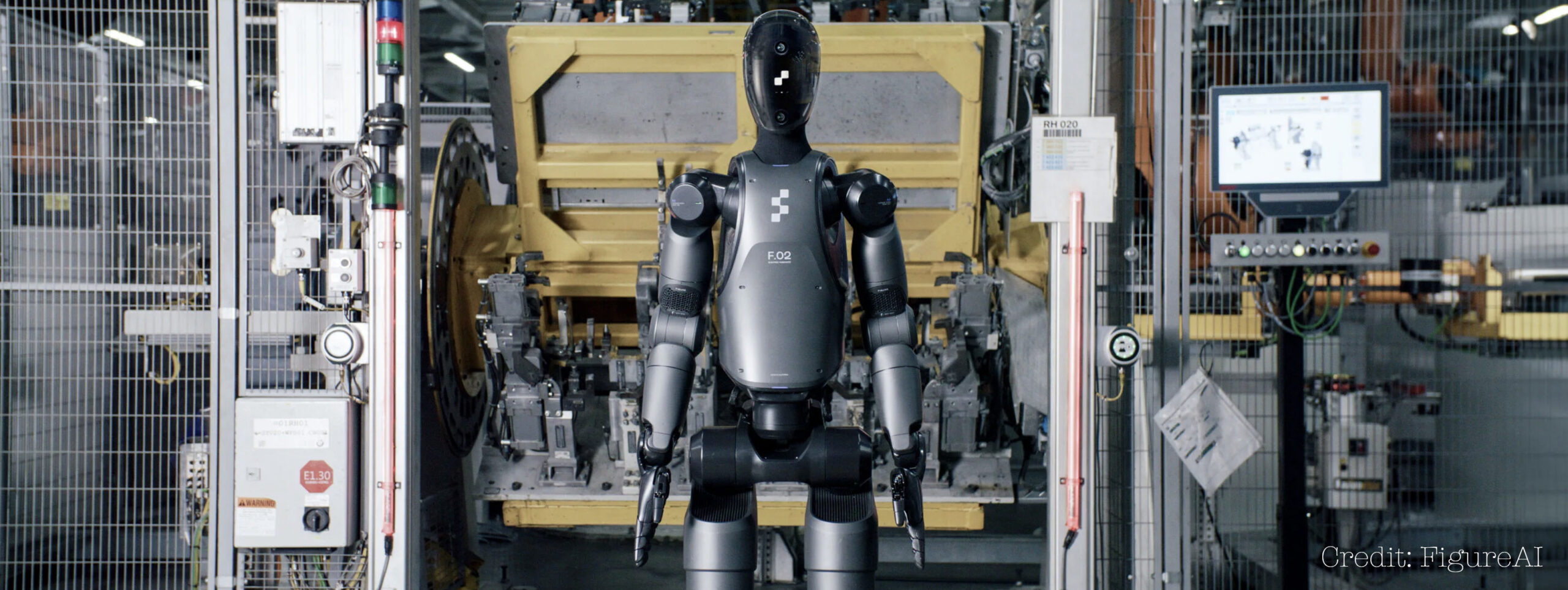
Building on earlier models, the Figure 02 Robot will begin alpha testing soon, earlier models has pilot in BMW South Carolina plant. Featuring enhanced bipedal mobility, tactile feedback systems, and energy-efficient actuators, Figure 02 excels in precision tasks like assembly and designed for industrial usage. Its vision-based navigation system reduces errors compared to predecessors. These innovations allows Figure 02 as cost effective automation option for requiring strength, durability and flexibility in the industrial environments.
Labor Force Robot Integration: Ethical and Economic Considerations
The introduction of humanoid robots like Helix and Figure 02 presents a nuanced landscape of opportunities and challenges:
Potential Positive Outcomes:
- Creation of new technical maintenance and programming jobs
- Reduction of dangerous and monotonous work for humans
- Increased overall economic productivity
Potential Challenges:
- Workforce displacement in certain sectors
- Need for comprehensive retraining programs
- Ethical considerations surrounding human-robot workplace interactions
See article for more information on Bipedal humanoid robots.
Humanoid Cost Analysis: Economic Implications
While initial investment in humanoid robots like Figure 02 might seem substantial, the long-term economic benefits could make business sense for example 24/7 operational capabilities, and elimination of human errors in repetitive tasks could make deployment of autonomous robots a liable solution in industrial environments.
Conclusion
FigureAI’s humanoid robots are undeniably transforming industries, offering unprecedented efficiency and cost savings. Yet, their integration demands careful navigation of ethical and economic landscapes. As AI advances, the future of work will hinge on collaboration between humans and machines where innovation complements, rather than replaces, the human touch. With companies like FigureAI, Boston Dynamics, Agility Robotics, Unitree the next decade promises a reimagined workforce, blending agility, intelligence, and empathy.